
Clean Water After the "All Clear"

Remember those high-stakes Sunday dinners with the extended family? The ones where your mom would give you "the look" and command you to sit up straight, smile through the boredom, and chew like you were on camera. “And no matter how many times Aunt Mildred pinches your cheeks, please, mind your P’s and Q’s!” That version of you was filtered. It was a stark contrast to a random Tuesday night at home, where everyone was inhaling tacos in their sweatpants and grabbing seconds without a second thought.
Then there is the "First Date" filter. You’ve got the polished hair, the outfit that makes you feel invincible, and a curated "resume" of your best life highlights. You’re sharing the achievements and the wit, while the less-than-glamorous chapters of your life story are tucked away for later. It’s not a lie; it’s just a very specific, high-end version of the truth.
Different Situations, Different Standards
In both cases, you are practicing filtration. You’re removing the "impurities" - the slouching, the bad habits, the boring stories - to suit the environment. But as you probably noticed, the "filter" you use for Aunt Mildred is vastly different from the one you use for a potential soulmate.
This might sound like the start of a self-help blog, and in a way, it is. Because when it comes to the water in your home, the word "filtration" has a massive range of meanings. Just because a label says "filtered" doesn't mean it's ready for the "First Date" (or your family's health).
If you’re going to take control of your water, you need to know exactly which version of "filtered" you’re getting.
Hi, my name is Morgan, a Preparedness Consultant here at 4Patriots. I work with people every day to create proper preparedness plans. I am also the lead instructor of all of our water filtration, storage, and catchment online courses. You can find these free classes here: 4patriotsuniversity.com.

But first a few facts
- The Three-Day Limit: Humans and most animals (including pets) can only survive about three days without water.
- The "3-Gallon" Rule: While emergency agencies suggest one gallon daily, a preparedness mindset plans for three gallons per person per day to cover drinking, cooking, hygiene, and other necessary uses that may arise.
- Water Quality: Most water isn't pure “H2O”; it contains a mix of additives and contaminants - some helpful, many harmful.
- Failing Infrastructure: National water systems are severely outdated, neglected, and increasingly prone to failure.
- Fixed Supply, Growing Demand: As the global population rises, water has become a finite commodity; we aren't "making" any more of it.
- Disasters Do Strike: As we enter tornado season, it’s a smart time to consider what your plan is if a storm leaves you without your basic necessities.
These facts make it imperative that we take control of our own water needs today.
What is Filtration?
The good old Miriam-Webster dictionary defines filtration as the act or process of filtering. Hmm, clear as mud. To filter simply means to pass a substance through a “device” to remove unwanted elements. So, when I am brushing the dry shampoo out of my hair, that’s filtering, right? Does that mean when I am mowing the lawn, I am “filtering” the grass? Deep thoughts to ponder.
As we enter tornado season, where the aftermath of a potentially destructive storm can leave us without the essentials we have become dependent on, we tend to think first of our power needs. But more time sensitive is our need to have clean water. A person cannot live more than 3 days without it, and after disaster strikes, the clock begins ticking.
So, when it comes to our water, what does filtration mean? It really depends on your water filtration system. Filtration could mean reducing the bacteria in your water by 80% or simply removing sediment from the creek water you collected. It pays to know what you are removing and what you are allowing to pass through!
Levels of Filtration
Think of filtration as a spectrum, on one side you have the shallow waters of exclusion of things we can see and on the other end the deep dive into removal at a microscopic level. Let’s step into the waters, shall we?.
Sediment Filtration removes sand, dirt, rust, small sticks, leaf particles. Things you can see in the water that are not water. Generally we call this “turbidity” - the things that make our water look dirty. Once removed, the water looks clear, but do not be fooled, at this point it is definitely not clean.
Sediment filters act as a screen or a net, not allowing particulates that are larger than the net holes to pass through. Simple.

Microfiltration (MF) is where we begin to remove things we can’t see but can certainly feel if they are allowed into our bodies and make us sick. A membrane is used to remove contaminants from the water, but at a much smaller level. But even then, microfiltration varies by membrane size, some microfilters only removing contaminants down to 10 micrometers, which is roughly the width of a cotton fiber. That still gives many dangerous things a free pass through.
At the finest, a microfiltration membrane, usually a hollow fiber membrane, will remove contaminants as small as 0.1 microns. That includes the removal of waterborne bacteria, like Cryptosporidium, and protozoa, like Giardia, and some (SOME) viruses, namely SARS-CoV-2 (Covid-19), Influenza and Ebola.
But, many waterborne viruses are still able to pass through, as they are simply smaller than the holes in the membrane filter. Some of these smaller viruses are Norovirus, Rotavirus, and Parvo. Most of your mobile filters, like those called a “straw” that are marketed to be used while camping and hiking, are microfilters. Think about that.
Ultrafiltration (UF) brings the process to a much finer level, the membranes in which the pore sizes range between 100 - 10 nanometers (0.01 to 0.1 microns), depending on the filter.
For context, there are 1,000 nanometers in 1 micron. A human hair is around 80,000-100,000 nanometers wide. A DNA molecule is about 2.5 nanometers wide. That is small.
Ultrafiltration uses pressure to drive water through a membrane that acts like a sieve, trapping contaminants onto its surface while water and water soluble minerals pass through. This is where we get into a finer filtration often used in medical dialysis. Ultrafiltration is used in the commercial beer and wine making processes, and it is increasingly being used as the final step in municipal drinking water filtration.
Many of the at-home countertop gravity-fed water filtration solutions on the market strive to accomplish ultrafiltration. Lucky for you, 4Patriots did the work to offer a mobile solution that goes the ultrafiltration mile. That’s the Personal Water Filter.

Nanofiltration (NF) gets down to .001 microns in removal. It removes bacteria, protozoa, viruses (the smallest of which is around 0.02 microns), natural organic material, and it doesn’t stop there. At the nanofiltration level, we have the ability to reduce and remove PFAS (forever chemicals), microplastics and some nanoplastics from our water, VOC’s (volatile organic compounds), hormones, pharmaceuticals, and all sorts of chemicals and heavy metals from our water.
At this level of filtration (some would call purification) dissolved compounds; like sodium chloride (table salt), sugar, vinegar and ethanol alcohol, remain. Nanofiltration also does not remove all minerals, which is a very positive fact, considering the human body needs minerals like calcium, magnesium and potassium.
Did you know that without these minerals, your body will actually end up excreting needed fluids and electrolytes in your urine, leaving you actually LESS hydrated. This is because, when deprived, your body will try to leach these minerals from tissue in order to use it elsewhere. These important minerals help pull water into our cells, and without them, electrolyte imbalance is a threat.
Reverse Osmosis (RO) removes all minerals and dissolved compounds. It rids the water of everything that is not two parts Hydrogen and one part Oxygen (H2O), rendering it squeaky clean. While this seems like the best and most obvious solution for clean water, there are problems with it.
1. RO systems are more vulnerable to breakage and upkeep because they consist of many parts. In each system you will have a series of 3-4 filters. Each one needs to be replaced routinely. So, what happens in the aftermath of a disaster when you are relying on your RO system and it breaks? That leaves you with no water solution.
2. RO systems remove minerals our bodies need, like Calcium for strong bones, Magnesium (sulfate) for regulating our blood sugar levels and balancing our electrolytes, and Potassium for regulating our nervous systems. When we drink water that has been essentially distilled at this level, our bodies end up excreting needed fluids, as described above. The solution? With RO, you must attempt to add the minerals back if you are going to be drinking this water. That’s right, we remove them just to add them back.
3. The process of reverse osmosis wastes approximately 4 gallons of water for every gallon it filters. If you ask me, I call that highly inefficient. So, if I have water stored for an emergency, let’s say, and I am needing to activate my emergency plan, I am going to have to use 5 gallons of water to get 1 gallon of drinking water.
4. Whole Home RO Systems are all the rage. If you can get past the three points I’ve made earlier, then there is one more to consider. Did you know that your tap water is powered by the grid? Yep. Electricity adds pressure (PSI) to the pipes to push that water up and out of your faucet into your sink. For those of us who have been without power for a day or two, we may not notice a problem.
However, after a few days of a power outage, the pressure in your pipes will disappear and your tap will not render you water. Frozen pipes or a busted water main can also incapacitate your whole home RO system.
Distillation is the process of boiling water to a steam that then condenses in the distiller to give you water free of minerals, heavy metals, bacteria and virus. So, here, we are not relying on size but on boiling point to accomplish filtration. Distillation does NOT however remove volatile organic compounds (VOCs). Those are chemicals coming from paint, floor varnishes, carpets and the like. Toxins you don’t want to ingest.
Additionally, just like with reverse osmosis, it is not healthy to drink distilled water, as it does not contain the minerals and electrolytes your body needs. Distillation is preferred for the use in medical devices like the CPAP and to clean hospital and operating rooms, laboratories, and medical tools.

The Daily Difference Filtration Makes
At this point, you may be saying to yourself that there’s no use in starting to filter your water now, because for so many years, you’ve been drinking water contaminated with who knows what! What good could it do to care now?
Three years ago I began getting serious about the water my family drinks and uses to cook with. Why? I took one hard look at my local water report and realized that there are contaminants that are allowed because their levels are within the Maximum Contamination Level (MCL). This level is set by the Environmental Protection Agency (EPA), and it’s based on a balance between human health and technical and economic feasibility. In other words, can we afford the technology to rid water of this contaminant at a deeper level? It’s not a matter of not wanting these contaminants out, it’s simply what the infrastructure can afford. These levels are re-evaluated every six years.
In my water report, the TTHMs (a byproduct of chlorine) were under the MCL level but close to it. I wasn’t present in those big government meetings where this acceptable level was established, so, like you, I’m hesitant to just believe the level present in my water is actually OK for my body. I also noticed on my water report that there were long lists of types of contaminants that they simply did not test for. Ignorance is bliss, I guess?
My reason for choosing to filter my water was this: Yes, I’ve been drinking all kinds of contaminants in my water all my life. Yes, I’m still alive. Yes, they could already be affecting me in ways I do not know. BUT just as much as the contaminants build up in your body over time, imagine how, conversely, overtime you can rid your body of those contaminants?
Our water pollution issue nationally and globally is not going to get any better. In fact, the more we use water - the more we manufacture, the more we live - the more our water will increasingly become polluted. There is so much we can’t control. But, why not control what we can? We CAN control the quality of the water we allow to enter our bodies. We can do that by being equipped with the knowledge, the right tools, and by cleaning that water ourselves.
So raise a glass of good water and let’s toast. Here’s to our self reliance!
The Simplicity of Filtering your Water
Whether wanting to be prepared for a big emergency situation in the future or making strides to mitigate future health issues by offering your body a healthier solution, water is the easiest plan to put in place! It takes some knowledge (all of the above), some simple math (how many people/pets in my household + how many gallons per day), and the right tools. That is it.
The Solution + Challenge
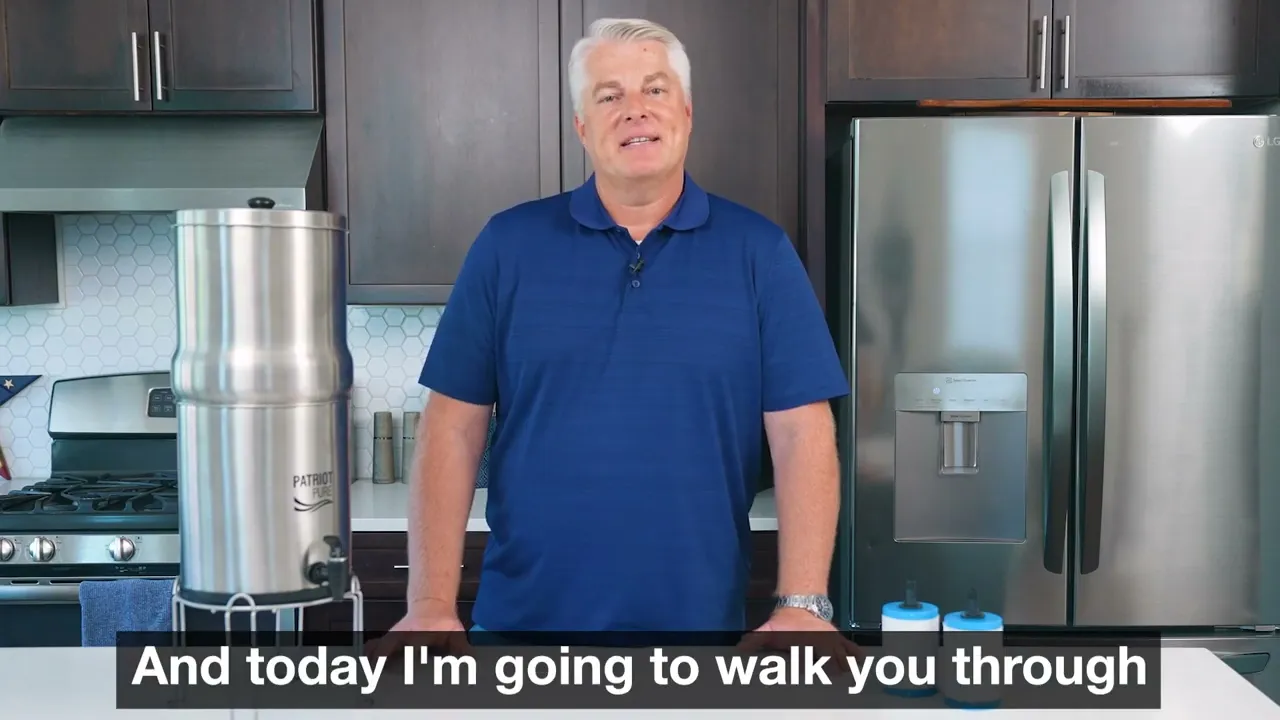
In order to filter down to a molecular level, have the ability to filter regardless of power or the tap producing water, and to maintain needed minerals in my body, I choose nanofiltration daily. I achieve this with the 4Patriots Ultimate Water Filtration System using the Nanomesh filter. I use it with my tap water daily, but I could also use creek or pond water in this robust system. It’s that tough on contaminants. And it’s so easy, my kids can use it.
My nephew came to visit over the holidays, and he took one sip of my water and said, ‘Yum!” He later told his mom, after they left to go home, “Mom, I want more of that good water.”
Good water, indeed. How very, very true.

Read More by Morgan:
Read More by Morgan:
Morgan is a dedicated Preparedness Consultant with over 2.5 years of experience at 4Patriots, where she has helped hundreds of individuals and families build customized emergency preparedness plans.
Specializing in water preparedness, Morgan teaches free online classes covering essential topics such as filtration, safe storage, and rainwater catchment. Her clear, hands-on guidance has made her a trusted resource in the preparedness community and a go-to expert for reliable water solutions.
A passionate advocate for self-reliance, Morgan makes herself available not only as a key instructor at 4Patriots University but also for one-on-one consultations.


