

The Science of Survival: How 4Patriots Generators Protect Sensitive Medical Gear
When the power grid fails, most people think about flashlights and candles. But for those relying on a CPAP machine or a nebulizer, the conversation isn't about light—it’s about power quality.
A single unseen detail in your backup power plan could be the difference between a safe night's sleep and a medical emergency.
Understanding a few basic concepts can help you make an informed decision for your family’s safety, regardless of which backup solution you choose.

1. The "Clean Power" Requirement (Pure Sine Wave)
Electricity isn't just "on" or "off." It moves in waves. Standard wall outlets in your home provide Pure Sine Wave power—a smooth, consistent curve.
Many affordable gas generators and cheap battery backups produce a "Modified Sine Wave." Instead of a smooth curve, the power moves in jagged, stair-step jumps. While a toaster doesn't care about "choppy" power, sensitive medical electronics do.
Running a CPAP on a modified sine wave can cause the motor to overheat, hum loudly, or even suffer permanent motherboard damage. This is why we engineered the Patriot Power Generator 2200X with a high-grade inverter that mirrors the clean power of your home’s outlets.
2. Understanding "Starting Watts" vs. "Running Watts"
A common mistake in emergency planning is looking only at the label on your device. A CPAP machine typically draws anywhere from 15 to 60 watts depending on its settings—running on the lower end of that range without a heated humidifier, and stepping up to the higher end when the heater is running.
However, the moment you turn the device on, the internal motor requires a brief "starting surge" of power that spikes higher than its continuous running wattage. When calculating your needs, always look for the peak surge capacity of your backup power source. If your generator can't handle that initial split-second spike, the unit will "trip" and shut down, leaving you in the dark.
3. The LFP Advantage: Why Battery Chemistry Matters
Not all lithium batteries are created equal. Older portable power stations and older cellphones frequently used Lithium Cobalt Oxide (LCO) batteries. While lightweight, LCO chemistry has a much shorter lifespan and lower thermal stability.
We've moved to Lithium Iron Phosphate (LFP) for the 2200X. Why?
- Stability: LFP is chemically much more stable. It virtually eliminates the dangers of traditional thermal runaway, drastically reducing the risk of hard-to-extinguish flames and explosions.
- Longevity: While a standard LCO battery might lose capacity after just 500 charges, an LFP battery can last for 3,500+ cycles.
For a senior on a fixed income, this means the unit is a one-time investment that won't need replacing in two years.
Real-World Testing
We recently hosted a Customer Appreciation Day at our headquarters in Nashville. As we spoke with folks from all over the country, a common theme emerged: the deepest worry wasn't necessarily a "doomsday" scenario.
We heard from dozens of you who stay awake during storms, listening for the sound of the CPAP motor, just waiting for the power to cut out. One customer was so moved by the peace of mind she finally got from her Patriot Power Generator that she actually asked to film a demo video for us.
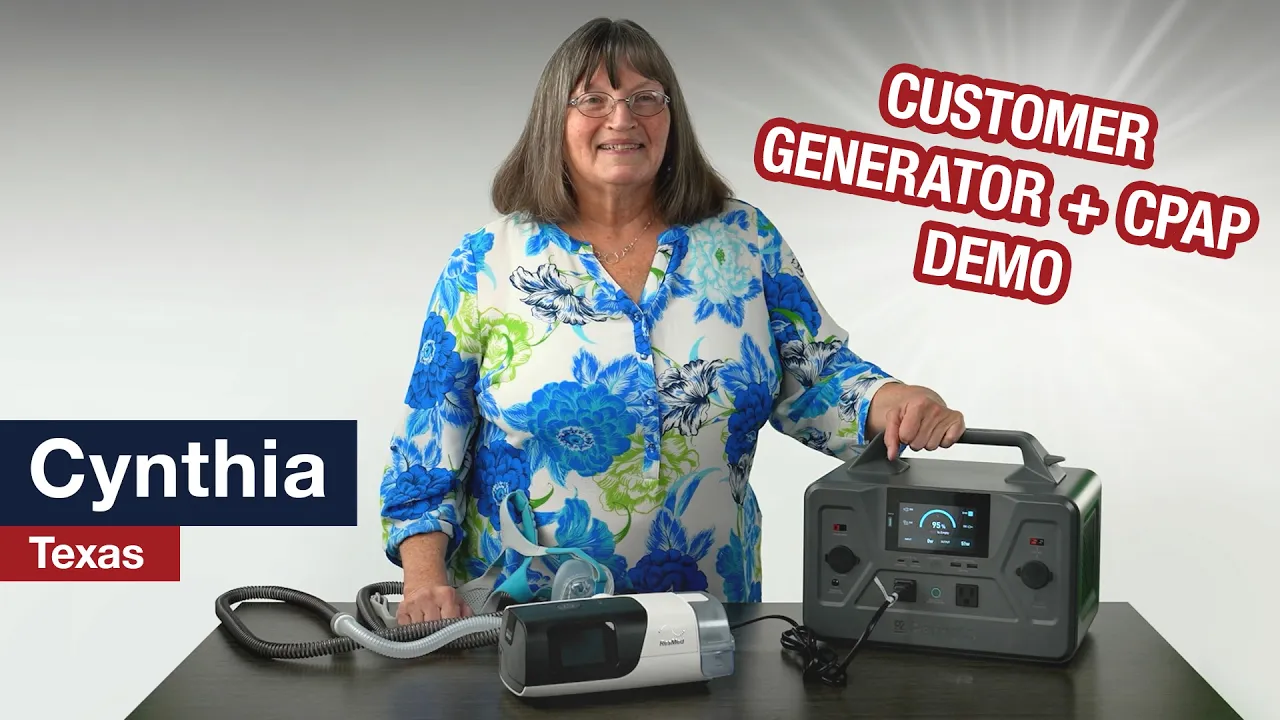
Whether you are protecting your own health or fulfilling your role as the family provider, you deserve a solution that works flawlessly without the noise, fumes, or technical headaches of old-fashioned generators.
Don't let the next storm be your "wake-up call." Secure your home front today so you—and your family—can finally sleep soundly tonight.
If you want to master the art of self-reliance, we’re here to help. Join one of our upcoming 4Patriots University Classes to get expert-led training on everything from off-grid power solutions to emergency food storage. You’ll walk away with the confidence and skills needed to feel truly prepared for life’s unexpected surprises.